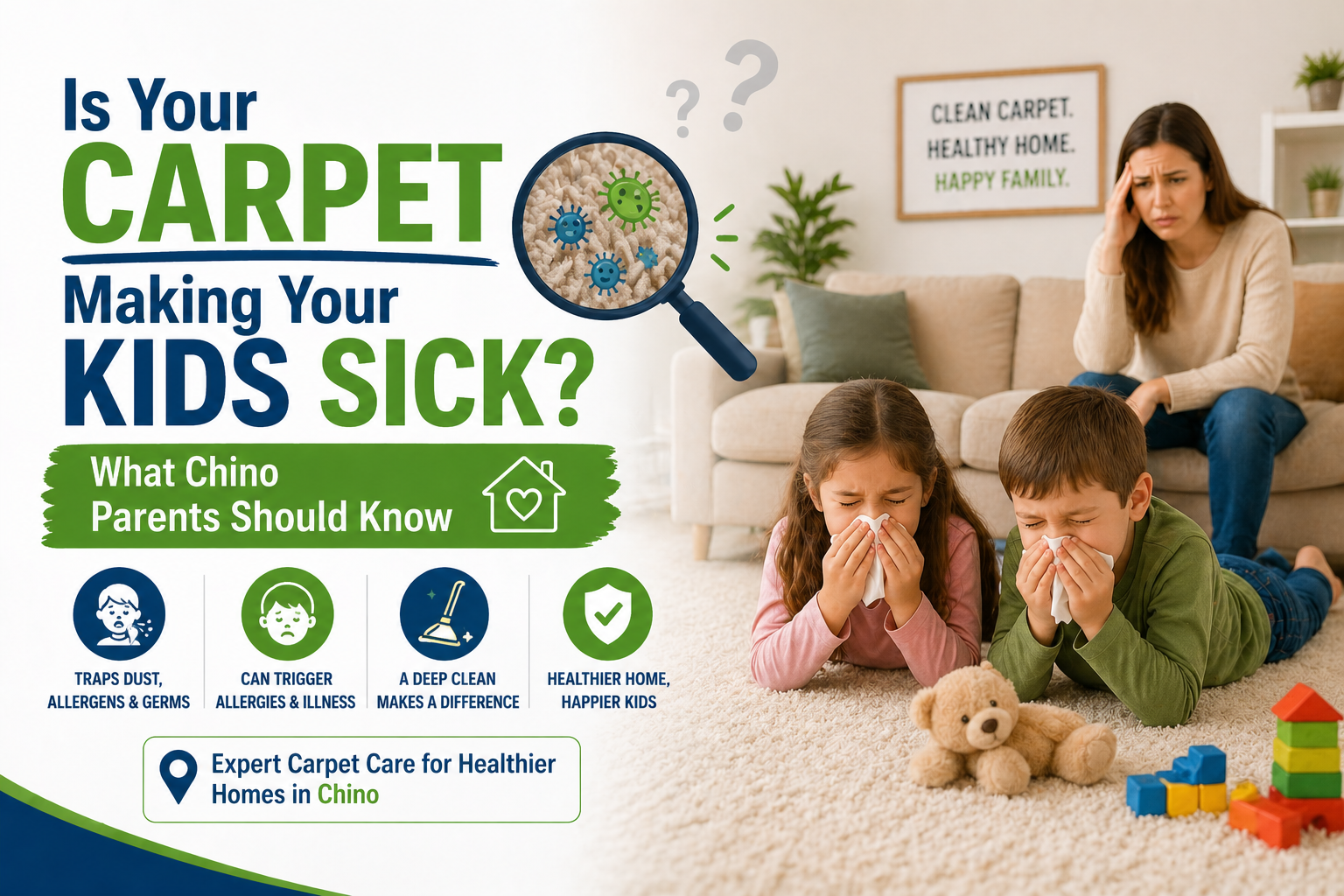
Is Your Carpet Making Your Kids Sick What Chino Parents Should Know
Most parents in Chino spend time thinking about what their kids eat, what they touch outside, and what they’re exposed to at school. Very few think about what’s living in their carpet — and what their children are breathing and touching every single day at floor level.
The reality is uncomfortable: carpet is the single largest reservoir for allergens, bacteria, dust mites, and indoor pollutants in most family homes. And children — who spend significantly more time at floor level than adults — are the most directly exposed. This guide explains what actually accumulates in residential carpet, how it affects children’s health, and what Chino parents can do about it.
What Carpet Actually Collects in a Family Home
Carpet functions as a filter. It traps airborne particles — dust, pollen, pet dander, mold spores, and fine particulate matter — preventing them from recirculating in the air. In that sense, carpet improves short-term air quality. The problem is that carpet never stops collecting and is almost never fully emptied.
Over weeks and months, residential carpet in a family home accumulates:
- Dust mites and their waste particles — the primary trigger for year-round allergic rhinitis in children
- Pet dander — present even in homes without pets, carried in on clothing from other environments
- Mold spores — particularly in areas exposed to moisture from spills, humidity, or tracked-in rain
- Pesticide residue — tracked in from lawns, parks, and outdoor surfaces on the bottoms of shoes
- Lead and heavy metal particles — common in older homes and near high-traffic roads
- Bacteria — transferred from shoes, pets, and food spills
- VOCs (volatile organic compounds) — off-gassed from carpet materials and cleaning products that accumulate over time
According to the EPA, indoor air can be two to five times more polluted than outdoor air — and in homes where carpets go without professional cleaning for extended periods, that gap widens significantly. The Inland Empire’s warm, dry climate compounds this: fine particulate matter from outdoor air, construction activity, and Santa Ana wind events enters homes and settles into carpet fibers at a higher rate than in more temperate regions.
How Indoor Carpet Pollutants Affect Children Differently Than Adults
Children are not simply small adults when it comes to indoor air quality exposure. Their physiology makes them meaningfully more vulnerable to the pollutants that accumulate in carpet.
Children breathe more air relative to body weight. A child’s respiratory rate is faster than an adult’s — meaning they inhale a greater volume of air per pound of body weight. Allergens, dust mite particles, and VOCs that an adult might inhale at a low dose are inhaled at a proportionally higher dose by a child in the same environment.
Children spend more time at floor level. Toddlers, crawlers, and young children play, roll, and rest directly on carpet surfaces — placing them in direct contact with concentrated allergen deposits and bacteria that an adult standing in the same room would never contact directly.
Children’s immune systems are still developing. Early and repeated exposure to allergens during immune system development can prime sensitization pathways — increasing the likelihood of developing persistent allergic conditions. The American Academy of Pediatrics has specifically identified indoor allergen reduction as a meaningful strategy for reducing allergic disease development in young children.
Dust mites thrive at floor level. Dust mite populations are densest in the lower 12 inches of a room’s environment — precisely where children spend the most time. A single square yard of carpet can harbor up to 100,000 dust mites under normal household conditions, according to the Asthma and Allergy Foundation of America.
Is Your Carpet Making Your Children Sick?
What are the signs that carpet allergens are affecting my child?
Watch for these patterns — particularly if symptoms appear indoors and improve when children spend time outside:
- Persistent runny nose or nasal congestion without a clear cold or viral cause
- Frequent sneezing — particularly in the morning after sleeping near carpet
- Itchy or watery eyes that improve after time spent away from home
- Coughing or wheezing that worsens indoors and at night
- Eczema flare-ups correlated with time spent playing on carpet
- Recurring respiratory infections — dust mite allergens can impair the respiratory mucosa’s ability to clear pathogens
If your child experiences multiple of these symptoms and they consistently improve during family travel or extended time away from home, indoor allergen load — including carpet-based allergens — is a reasonable area to investigate with your pediatrician or allergist.
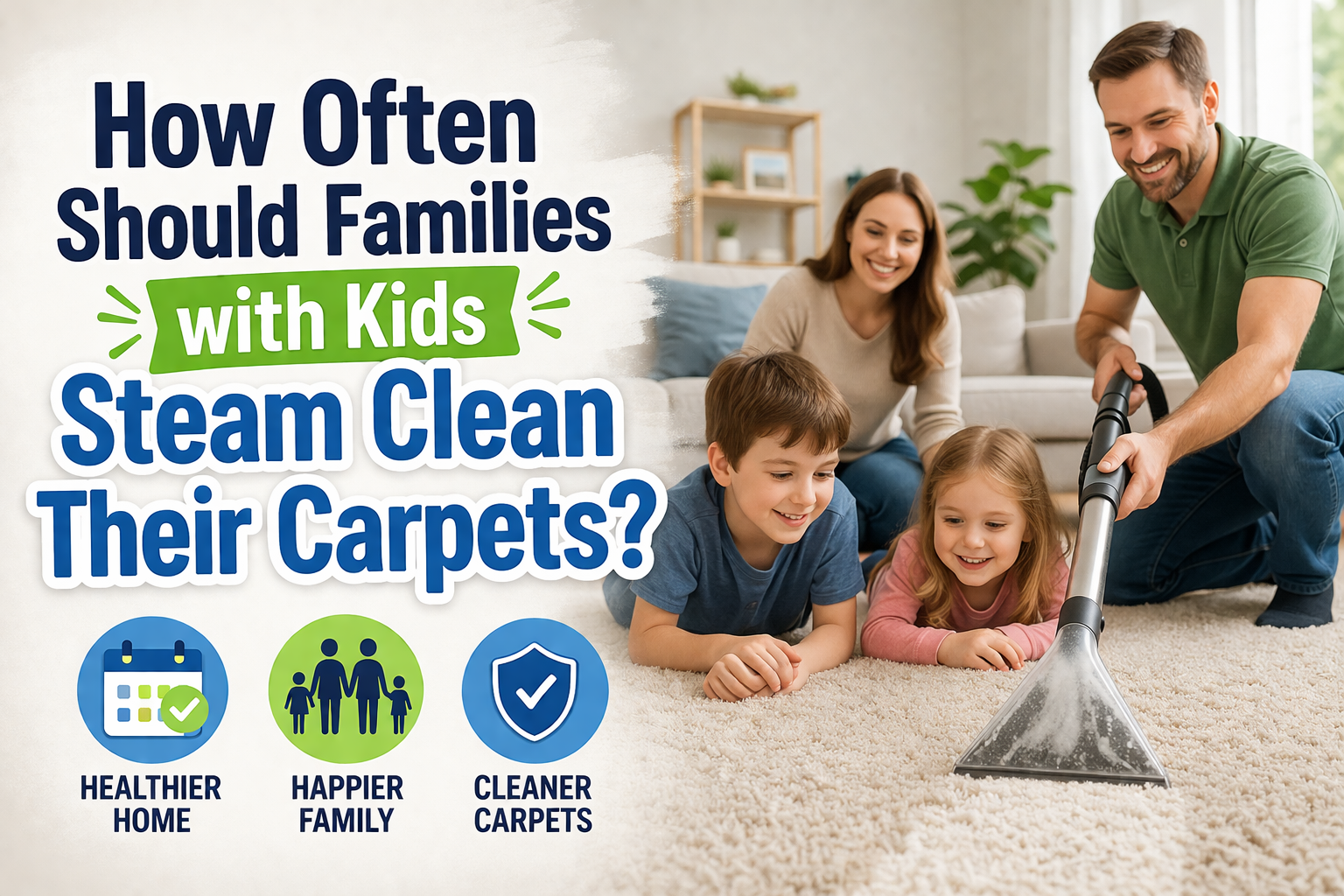
How often should families with allergic children clean their carpets?
For households where a child has confirmed allergic rhinitis, asthma, or eczema, professional carpet steam cleaning every 3–6 months is the recommended interval. This frequency, combined with weekly HEPA-filter vacuuming and regular washing of soft furnishings, provides the most consistent management of dust mite populations and allergen load in the home environment.
For families without confirmed allergic conditions, every 6–12 months maintains carpet at a level that supports healthy indoor air quality without allowing allergen accumulation to reach clinically significant levels.
Professional carpet steam cleaning using hot-water extraction is the most effective method for reducing dust mite populations, removing allergen deposits, and extracting the accumulated contaminants that vacuuming leaves behind.
Are eco-friendly carpet cleaning products actually safer for kids?
Yes — and the distinction matters. Conventional carpet cleaning products can contain surfactants, solvents, and fragrances that leave chemical residue in carpet fibers. Children crawling on recently cleaned carpet with conventional products are in direct contact with those residues.
Eco-friendly, non-toxic cleaning solutions — like those used by Neighborhood Hero Cleaning — use biodegradable formulations with no harsh chemical residue. The carpet is genuinely safer for children once dry, not just visually cleaner. This is particularly important for infants and toddlers whose hand-to-mouth behavior means carpet residue is literally ingested.
Carpet Health Risks Specific to Chino and the Inland Empire
Chino and the surrounding Inland Empire communities face specific environmental factors that accelerate carpet contamination compared to other California regions.
Construction activity in rapidly developing communities like New Model Colony, Ontario Ranch, North Eastvale, and Temescal Valley generates fine silica dust and particulate matter that enters homes on shoes, clothing, and through HVAC systems — settling into carpet fibers at elevated rates compared to established neighborhoods.
Santa Ana wind events drive high concentrations of fine outdoor particulate matter indoors. Families in South Chino Hills, Rolling Ridge, Eagle Glen, and Rancho Etiwanda — communities with significant exposure to seasonal wind patterns — see faster carpet soiling during wind seasons than the annual cleaning recommendation accounts for.
Warm year-round temperatures in Chino, Norco, Eastvale, and Corona maintain conditions favorable to dust mite reproduction throughout the year. Unlike colder climates where dust mite populations decline seasonally, Inland Empire homes provide a consistently warm, inhabited environment that supports year-round dust mite activity at high levels.
High pet ownership across the region — particularly in Norco with its equestrian communities and throughout Chino Hills, Arlanza, and Mission Grove — means pet dander is a near-universal carpet contaminant in area homes, regardless of whether the household itself has pets.
For families in these communities, the national baseline recommendation of annual professional cleaning should be treated as a minimum — not an optimal schedule.
What Professional Carpet Cleaning Removes That Vacuuming Cannot
Vacuuming is essential maintenance — but it has hard limits. A quality vacuum with a HEPA filter removes surface debris and some airborne allergens effectively. What it cannot do:
- Reach contamination below the surface layer — dust mites, their waste particles, and bacteria colonize the middle and lower layers of carpet pile where vacuum suction cannot generate sufficient force
- Extract oils and sticky residues — body oils, food residue, and tracked-in substances bond to fibers and act as adhesive for subsequent allergen accumulation
- Neutralize odor sources — bacteria and uric acid compounds that produce odors are embedded in the backing, not the surface
- Remove mold spores from backing material — moisture-related mold growth in carpet backing requires extraction at temperatures and pressures only professional equipment achieves
Professional carpet steam cleaning using hot-water extraction addresses all of these limitations. Pressurized hot water penetrates the full depth of carpet pile, loosening and extracting contamination from every layer — including the backing — before professional-grade suction removes the dissolved material completely.
Practical Steps Chino Parents Can Take Right Now
You don’t have to wait for a professional appointment to start reducing your children’s allergen exposure:
- Remove shoes at the door — every time. The ISSA Cleaning Industry Research Institute estimates this single habit reduces carpet soiling by approximately 85%. More importantly, it dramatically reduces the pesticide residue, bacteria, and heavy metal particles tracked in from outside.
- Vacuum with a HEPA-filter vacuum 3 times per week in rooms where children play and sleep. Standard vacuum filters recirculate fine particles — HEPA filters capture them.
- Wash children’s stuffed animals and soft toys monthly. Soft toys are secondary dust mite reservoirs that transfer allergens to carpet during play.
- Keep indoor humidity below 50%. Dust mites thrive above 50% relative humidity. Southern California’s dry climate naturally supports lower humidity — use air conditioning rather than evaporative cooling where possible.
- Schedule professional carpet cleaning before allergy seasons. In the Inland Empire, spring pollen season and fall Santa Ana wind season represent peak indoor allergen load periods. Professional cleaning in late winter and early fall provides the cleanest baseline entering each high-exposure period.
Ready to Reduce Your Family’s Indoor Allergen Load in Chino?
If your children spend significant time at floor level — or if anyone in your household has allergies, asthma, or eczema — professional carpet steam cleaning is one of the most evidence-backed steps you can take to reduce their indoor allergen exposure.
Blake Washington and the Neighborhood Hero Cleaning team serve families across Chino, Chino Hills, Eastvale, Ontario, Rancho Cucamonga, Corona, and the Inland Empire with professional carpet steam cleaning — using eco-friendly, non-toxic solutions that are completely safe for children and pets, with fast dry times and a free deodorizer on every visit.
No contracts, no pressure. Just a healthier home for your family.
Call Blake at (951) 800-3827 or request a free quote online. Same-day service available.
Frequently Asked Questions
Can carpet cleaning help with my child’s asthma? Professional carpet cleaning reduces the dust mite populations and allergen deposits that are among the most common asthma triggers in children. The American Lung Association includes regular carpet cleaning as part of recommended indoor asthma management strategies. While cleaning alone does not treat asthma medically, reducing indoor allergen load through regular professional cleaning is a meaningful environmental intervention that can reduce trigger frequency.
How soon after carpet cleaning is it safe for my baby to crawl on the floor? With eco-friendly, non-toxic cleaning solutions, carpets are safe for infants once fully dry — typically 4–6 hours after steam cleaning. There is no chemical residue concern with biodegradable professional solutions. Good ventilation during and after cleaning accelerates drying and reduces any temporary odor from the cleaning process itself.
Does carpet type affect how many allergens it holds? Yes. Cut-pile carpets — the most common residential type — trap more allergens than loop-pile constructions. Lower pile heights accumulate less than deep shag carpets. However, all carpet types accumulate allergens over time regardless of construction, and all benefit from regular professional cleaning to maintain healthy allergen levels.
What’s the difference between cleaning for appearance and cleaning for health? Cleaning for appearance addresses visible soil and surface staining. Cleaning for health targets the invisible contamination — dust mite populations, allergen deposits, bacteria, and VOC residues — that accumulates below the surface and affects indoor air quality. A carpet can appear clean while harboring significant allergen loads. Professional hot-water extraction addresses both simultaneously.
Should I replace carpet with hard flooring if my child has allergies? Hard flooring does reduce carpet-specific allergen accumulation — but it increases airborne allergen levels because hard surfaces don’t trap particles the way carpet does. The EPA notes that well-maintained carpet can actually support better air quality than hard flooring in allergy-managed homes because it holds allergens in place until they can be removed by vacuuming, rather than allowing them to recirculate continuously. Regular professional cleaning of maintained carpet is a viable alternative to flooring replacement for most allergy-affected households.
Author: Blake Washington, Owner — Neighborhood Hero Cleaning, Chino, CA. Serving families across the Inland Empire with professional carpet, upholstery, and tile cleaning.